A plastic pipe penetration can look routine right up until the firestop inspection. Then the questions become specific: What is the pipe material? Is it insulated? What is the annular space? Does the selected system cover this wall or floor construction, this orientation, and this exact installation detail? Firestop collars versus wraps is not a simple product preference. It is a listed-system decision that affects life safety, inspection results, and whether a crew has to reopen finished work.
For commercial projects, the correct answer starts with the tested and listed assembly, not with whichever intumescent product is already on site. Both collars and wraps are designed to address combustible penetrants that can melt or burn away in a fire. Both can be part of compliant systems. Their approved applications, installation details, and field risks are different.
Why Plastic Pipe Requires a Firestop System
A rated wall or floor is only as reliable as the penetrations passing through it. PVC, CPVC, ABS, polypropylene, and similar combustible pipes can soften, melt, or burn during a fire, leaving an opening through which flame and hot gases can pass. An intumescent firestop component expands when exposed to heat, crushing or closing the opening left by the pipe.
That reaction must occur within a tested configuration. The firestop sealant, mineral wool, pipe size, pipe schedule, sleeve condition, wall or floor type, annular space, and support arrangement may all be part of the UL-listed system. A collar or wrap cannot be selected in isolation and assumed to produce the same rating.
The applicable listing commonly addresses fire-resistance performance under UL 1479 or ASTM E814. Depending on the project requirements, the system may also need to satisfy temperature, smoke leakage, water resistance, or other performance criteria. The design professional, code requirements, and authority having jurisdiction determine what is required. The installer’s job is to build the approved detail exactly.
Firestop Collars Versus Wraps: The Core Difference
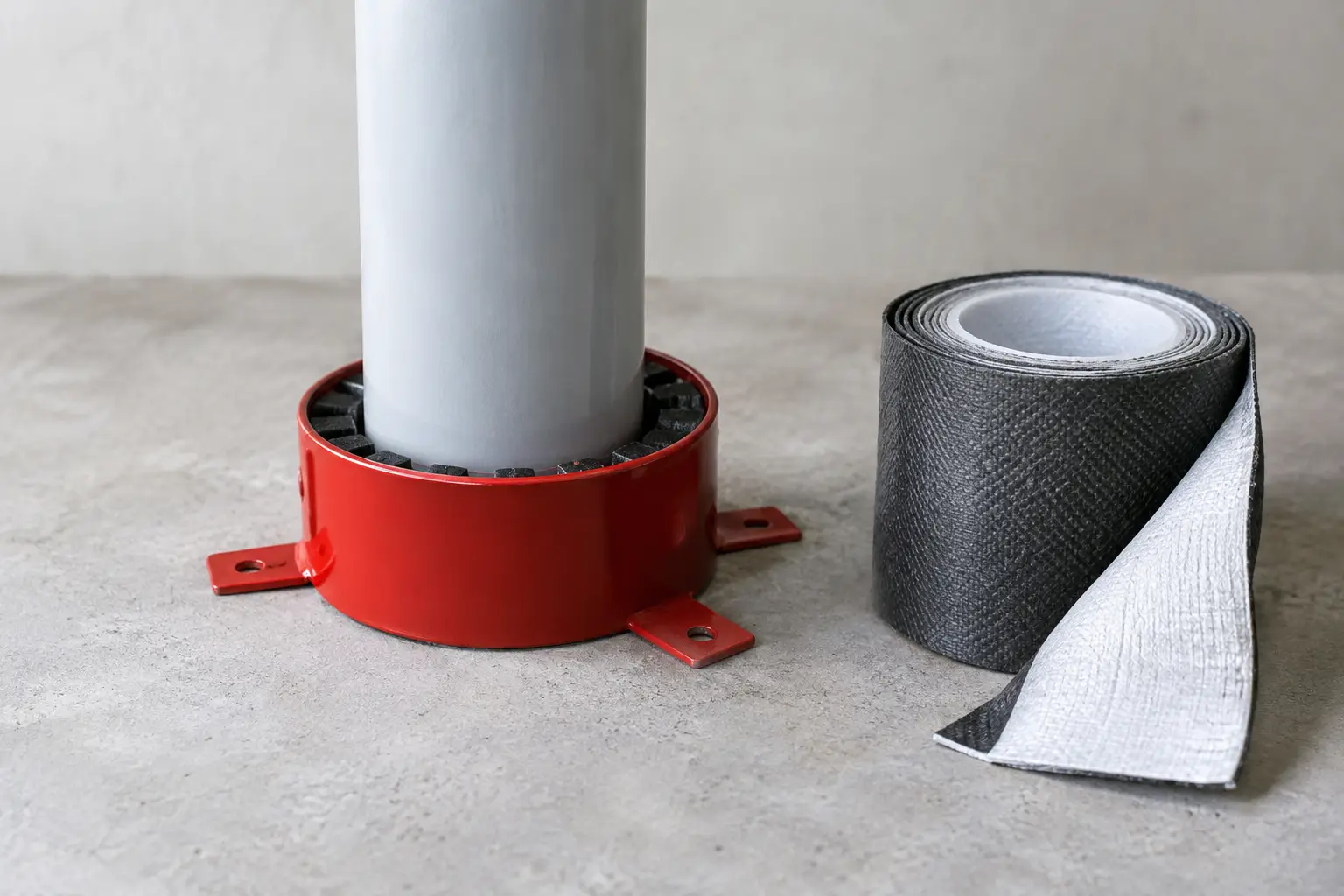
A firestop collar is typically a steel housing containing an intumescent insert. It is installed around the outside of a combustible pipe at the face of the rated assembly, using the attachment method and location stated in the listing. As heat rises, the insert expands inward as the pipe deforms or disappears.
A firestop wrap uses intumescent strip material wrapped around the pipe, usually within the opening or sleeve. The wrap is often combined with specified fill material and firestop sealant. It becomes part of a more concealed penetration detail rather than a surface-mounted device.
The practical distinction is installation location and restraint. A collar is a manufactured assembly with a visible metal shell and listed fastening requirements. A wrap is configured in the field according to the listing, which may prescribe the number of layers, overlap, wrap width, placement depth, and accompanying sealant or backing material. Neither is automatically better. The tested assembly decides which is acceptable.
Where Collars Can Be the Better Fit
Collars are often effective when the listed system calls for a surface-mounted intumescent device and there is clear access to install it correctly. They can be a straightforward option at exposed pipe penetrations, particularly where the required collar can be fastened to the concrete or gypsum assembly without conflicting with adjacent work.
Their visibility can also support inspection. A properly installed collar is easier for an inspector to identify than an intumescent component concealed inside the opening. That does not eliminate the need for system labels, photographs, and closeout documentation, but it can make field verification more efficient.
The trade-off is coordination. Collars need room around the pipe and an appropriate substrate for attachment. Congested mechanical rooms, tightly grouped penetrations, shallow slab conditions, or clashes with hangers and insulation can make a collar difficult or impossible to install as listed. Fastener type, quantity, spacing, and placement are not minor details. A collar that is missing required anchors or attached to an unapproved surface is not the tested system.
Where Wraps Can Be the Better Fit
Wrap systems can be useful where a listed assembly requires the intumescent material inside the penetration, where surface clearance is limited, or where the opening configuration is better suited to a concealed solution. They can accommodate conditions that would be difficult to address with a rigid, surface-mounted collar, provided the listing specifically permits the condition.
Wraps demand disciplined installation. The number of wraps, the orientation of seams, the depth within the assembly, and the amount of sealant or mineral wool all matter. A wrap installed one layer short, placed at the wrong depth, or substituted with a different sealant can fail inspection even when the finished penetration appears fully sealed.
They also require careful control when pipe insulation is involved. Some listings address bare pipe only. Others permit specific insulation types, thicknesses, or interrupted-insulation details. Wrapping over an unapproved insulation configuration is not a field adjustment. It is a deviation that needs a properly engineered or listed solution before the work is closed.
The Conditions That Actually Drive Selection
The penetrant comes first. Pipe material, diameter, wall thickness, and whether it is solid, cellular-core, or a specialty plastic all affect what systems are available. The assembly comes next: concrete floor, concrete wall, shaft wall, gypsum wall, or a framed assembly may require entirely different details.
Then evaluate the opening itself. A penetration through a sleeve is not always treated the same way as a direct opening. Annular space must remain within listed limits, and oversized holes should not be corrected by adding product until the system is verified. The pipe’s orientation also matters. A system approved for a horizontal pipe through a wall is not automatically approved for a vertical pipe through a floor.
Field accessibility is the final major factor. A system may be technically available but impractical if other trades have already boxed in the penetration, installed ceiling systems, or blocked the required installation face. This is why early firestop review protects the schedule. Selecting an approved system before rough-in is complete costs far less than opening walls after inspection.
Common Installation Failures That Create Rework
The most expensive firestop problems are usually small departures from the listing that remain hidden until inspection. A familiar product name on the tube or collar does not prove that the installed configuration is compliant.
Common issues include:
- Using a collar where the listing requires wraps, or the reverse.
- Installing a collar on only one side when the listed wall system requires protection on both sides.
- Omitting required mineral wool, sealant depth, or backing material around a wrap.
- Exceeding the listed annular-space limit after pipes are relocated or openings are enlarged.
- Installing a system intended for bare pipe over insulated pipe or through an unapproved sleeve condition.
- Covering the work before it is inspected, photographed, and labeled.
These failures can disrupt more than the firestop scope. They can delay ceiling closure, final inspections, occupancy milestones, and turnover documentation. On a fast-moving commercial project, the cost is often not the material. It is the coordination required to gain access, remove finishes, correct the detail, and reinspect it.
Build the System, Then Document It
An inspection-ready firestop process starts with verified listings and submittals that match the actual construction. The field team should confirm penetrant conditions before installation, coordinate exceptions early, and install products from the listed manufacturer system. If the existing condition falls outside available listings, it should be addressed through the appropriate engineering and approval path, not improvised in the field.
Documentation should make the work traceable. System numbers, installation locations, product identification, and photographic records help the general contractor, owner, and inspector confirm what was installed. This is especially valuable on phased projects, healthcare work, occupied facilities, and projects with substantial closeout requirements.
Colonial Fireproofing approaches collars and wraps as components of a complete passive fire-protection scope, not as interchangeable fixes. With access to thousands of UL-rated firestop assemblies and certified STI instructor oversight, the goal is to resolve the condition before it becomes a failed inspection or a schedule problem.
When a combustible pipe penetration is approaching close-in, pause long enough to verify the listed detail. That short check can preserve the rated assembly, protect the inspection date, and keep a small penetration from becoming a major rework item.