A concrete deck pour is not the time to find out that a penetration detail was never coordinated. The decision between cast-in devices versus sleeves affects more than layout: it can determine whether the finished opening supports a listed firestop system, whether trades can install their work cleanly, and whether the assembly is ready when the inspector arrives.
For commercial projects, neither option is automatically better. The correct choice depends on the rated assembly, penetrating item, opening size, movement expectations, trade sequencing, and the specific UL-listed system being used. What matters is making that decision before concrete placement, documenting it clearly, and installing the selected system exactly as tested.
Cast-In Devices Versus Sleeves: The Core Difference
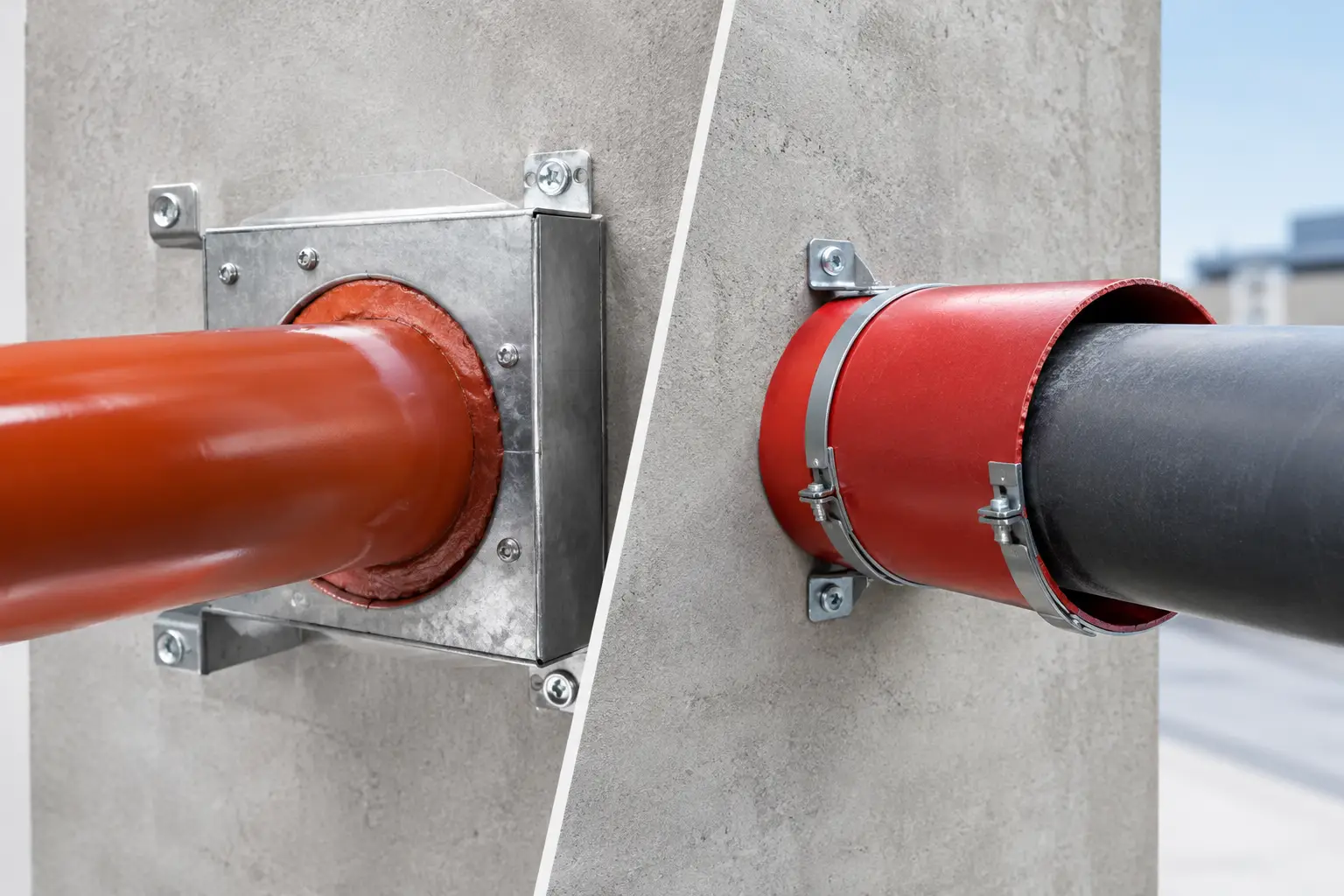
Cast-in devices are purpose-built components installed in formwork or reinforcing layouts before concrete is poured. Depending on the application, they may create a protected opening, provide an integral firestop solution for a specific penetrating item, or establish the geometry needed for a tested system. They are often selected for repetitive conditions, particularly where penetrations through floor slabs are known early and coordinated across multiple trades.
A sleeve is generally a section of pipe, steel, or another approved material placed through a wall or floor to create an opening for future piping, conduit, cable, or ductwork. The sleeve itself is not automatically a firestop system. Once the penetrating item is installed, the annular space and the conditions at the sleeve must match a tested and listed firestop assembly.
That distinction is where jobs can get into trouble. A sleeve may be a necessary part of the penetration detail, but it does not by itself restore the fire-resistance rating of a wall or floor. A cast-in device may offer a more defined solution, but only when its use matches the manufacturer instructions and the listing governing that condition.
When Cast-In Devices Make Sense
Cast-in devices are most effective when the penetration type, location, and size are established before the pour. On a coordinated commercial project, that can reduce follow-up drilling, minimize slab damage, and give MEP trades designated pathways through rated floor assemblies.
They are particularly useful for recurring penetrations in multistory construction, where repeatability matters. When dozens or hundreds of similar riser, conduit, or pipe locations are required, a properly selected cast-in approach can improve field consistency. It also gives the project team an opportunity to establish approved details before the concrete locks the condition in place.
The schedule benefit is real, but only if coordination is real. A cast-in device installed in the wrong location, at the wrong elevation, or for the wrong service is not a time saver. It can become an obstruction that forces field modifications, core drilling, patching, or a new firestop engineering review.
Cast-in solutions also require close attention to what will penetrate them. Pipe material, pipe diameter, insulation, cable bundle size, conduit type, and whether the penetration is empty or occupied all affect the available firestop options. A device that works for a nonmetallic pipe condition may not work for insulated metallic pipe or a large cable bundle. The tested system, not a general preference, must drive the decision.
When Sleeves Are the Better Choice
Sleeves can provide valuable flexibility when final MEP routing is still developing or when a project requires larger, varied, or specialty penetrations. They are common in rated walls and floors, especially where the penetrating item will be installed after the structure is complete.
A properly sized sleeve can help protect the surrounding construction during installation and create a defined annular space for an approved firestop system. That does not mean any sleeve size will work. Oversized openings can leave annular spaces beyond what a tested system allows, while undersized sleeves may prevent proper installation or force trades to compromise required clearance.
For sleeves, the details matter: sleeve material, sleeve gauge, sleeve projection, opening dimensions, penetrating-item type, annular space, insulation configuration, and sealant depth can all be controlled by the selected UL system. The firestop installer needs those conditions to be correct before installation begins.
Sleeves are often the practical answer where field conditions are less predictable. But flexibility should not become a substitute for planning. If sleeves are left unprotected, abandoned, improperly capped, or filled with unapproved materials, the rated assembly remains incomplete and inspection exposure increases.
The Firestop Listing Decides the Detail
The question is not simply whether to use a cast-in device or a sleeve. The question is: which tested system applies to this exact penetration through this exact rated assembly?
UL-listed firestop systems identify the permitted construction type, hourly rating, penetrating item, opening size, fill materials, backing requirements, sealant depth, and other installation limits. Manufacturer instructions and local authority having jurisdiction requirements must be considered alongside the listing. A detail that appears similar in the field can still fall outside the tested configuration.
For example, a cast-in device may be listed for a specific pipe material and diameter through a concrete floor of a minimum thickness. Changing the pipe, adding insulation, increasing the annular space, or using the device in a different assembly can invalidate the intended detail. The same principle applies to a sleeved opening. A penetration that looks properly sealed may still fail inspection if the system does not support the actual condition.
This is why firestopping should not be treated as a final punch-list activity. By the time a firestop contractor is called to solve an uncoordinated penetration, the options may be narrower, slower, and more expensive than they were before the concrete pour or wall close-in.
Coordination Points Before Concrete Placement
The strongest results come from reviewing penetration strategy during preconstruction and again before formwork and pours. General contractors, concrete teams, MEP coordinators, and firestop specialists should confirm which openings need cast-in devices, which need sleeves, and which are better handled through approved post-installed methods.
The review should address the rated assembly, expected service, location, opening dimension, and trade ownership. It should also identify conditions that frequently create rework, including grouped penetrations, pipe insulation, seismic movement, deck flutes, shaft walls, and future-use openings.
Documentation matters as much as the discussion. Approved details should be available to field crews, and installed conditions should be captured for closeout. Clear records help the superintendent verify work before concealment, support special inspection activity when required, and give facility teams a reliable reference after turnover.
Common Field Failures to Prevent
A sleeve that is too large for the selected firestop system is one of the most common preventable problems. Another is assuming that a generic sealant application can resolve any annular space. Firestop materials are system components, not universal fillers.
Other recurring issues include cast-in devices installed off layout, sleeves omitted from rated walls, penetrations added after the pour without an approved detail, and MEP changes that alter the conditions originally reviewed. Empty sleeves can also be missed, especially when future tenant work is anticipated. Every unprotected opening in a rated assembly needs a compliant, documented solution.
Inspection failures often trace back to a simple breakdown in ownership. The concrete contractor may install the sleeve, the plumber may run the pipe, and the firestop contractor may arrive after walls are closed or ceilings are crowded. Without an agreed detail and an accessible work area, the final installer is asked to correct conditions that should have been resolved much earlier.
A Practical Decision Process
Start with the rated assembly and the required service. If the penetration is repetitive, well-defined, and coordinated before the pour, a listed cast-in device may offer a controlled, efficient path. If routing, size, or service type remains variable, a sleeve paired with an appropriate listed firestop system may provide the necessary flexibility.
Then verify the actual listing before materials are installed. Confirm that the concrete thickness, opening size, penetrating item, insulation, annular space, and firestop materials all fit the tested system. If they do not, stop and resolve the condition before it becomes concealed work.
Colonial Fireproofing helps project teams evaluate these details against available UL-rated assemblies, manufacturer requirements, and inspection expectations. The goal is not to force every condition into one approach. It is to establish a compliant detail that crews can execute consistently under real jobsite pressure.
Before the next pour, bring the firestop review into the coordination meeting. A few minutes spent confirming cast-in devices, sleeves, and listed systems can prevent a failed inspection, a costly core drill, and a life-safety detail left to chance.